Advertisement

UTeM BMFR Google Search Engine

Calculations using Boyle's Law
Concepts
Boyle's Law states that the product of the pressure and volume for a gas is a constant for a fixed amount of gas at a fixed temperature. Written in mathematical terms, this law is
A common use of this law is to predict how a change in pressure will alter the volume of the gas or vice versa. Such problems can be regarded as a two state problem, the initial state (represented by subscript i) and the final state (represented by subscript f). If a sample of gas initially at pressure Pi and volume Vi is subjected to a change that does not change the amount of gas or the temperature, the final pressure Pf and volume Vf are related to the initial values by the equation
Exercise
Objective
- Use Boyle's Law to predict the final pressure for a gas that has undergone an expansion.
In both parts of this exercise, you will work with two glass bulbs connected by a tube containing a stopcock. Initially, the bulb on the right is completely evacuated (that is, it contains no gas) while the bulb on the left contains a sample of gas at pressure Pi. A manometer is provided to measure the pressure in the left bulb.
When the stopcock is opened, the gas in the left bulb will expand to occupy both bulbs and the pressure in the left bulb will change accordingly.
Information on the volumes of the two bulbs will be given to you, and you may read the initial pressure from the manometer. Use Boyle's Law to calculate the final pressure. Then open the stopcock and see if your prediction is correct.
Part 1
Each time you press the "New Conditions" button, the experiment will be reset with new volumes for the two bulbs and a new initial pressure. After calculating the final pressure, press the "Open Stopcock" button to allow the gas to expand and check your prediction.
Practice the calculations until you are able to solve the problem consistently.
| Volume of Left Bulb L | Volume of Right Bulb L | |
Part 2
In performing the Boyle's Law calculations in Part 1, you will no doubt have observed that it is not necessary to know the initial and final volumes. It is only necessary to know the volume ratio: Vi/Vf.
This part of the exercise is the same as Part 1 except you are not given the volumes of the two bulbs. Instead you are given the ratio of the two volumes: Vright/Vleft.
Repeat the exercise using the volume ratio in the calculations. Bear in mind that Vright/Vleft is not the same as Vi/Vf .
| Vright/Vleft = |
The formula at the top of the page is Boyle's Law, named after the British chemist Robert Boyle (1627 - 1691). It states that the volume of a fixed mass of gas at a constant temperature is inversely proportional to the pressure of the gas.
In less formal terms:
When pressure increases, volume decreases.
When volume increases, pressure decreases.
So there !!!
As a practice example, 8 liters of a gas has a pressure of 760 torr. Calculate the volume if the pressure increases to 1520 torr with the temperature remaining constant.
Your answer should equal 4 liters.
Answers are displayed in scientific notation and for easier readibility, numbers between .001 and 1,000 will be displayed in standard format (with the same number of significant figures.)
The answers should display properly but there are a few browsers that will show no output whatsoever. If so, enter a zero in the box above. This eliminates all formatting but it is better than seeing no output at all.
Pressure Volume Relationships
We are used to living at 1 ATM of pressure, so we rarely even take notice of it. We normally don't feel the pressure on us because the human body is primarily made up of liquid, and liquids are basically non compressible. At times, however, we do notice changes of pressure, primarily in our ears. You may have noticed your ears "popping" when flying, driving in the mountains, or even going up and down in elevators. This is because our ears have an air space in them, and air, like all other gases, is compressible.A gas will compress proportionately to the amount of pressure exerted on it. For example, if you have a 1 cubic foot balloon and double the pressure on it, it will be compressed to 1/2 cubic foot. Increase the pressure by 4, and the volume will drop to 1/4 the size etc. This theory was discovered by Sir Robert Boyle, a 17th century scientist. The theory known as Boyle's Law states: If the temperature remains constant, the volume of a given mass of gas is inversely proportional to the absolute pressure.
Let's follow an example...
Suppose you had a balloon measuring one cubic foot at the surface of the water. This balloon is under 1 ATM (14.7 psi) of pressure. If we push the balloon underwater, and take it to a depth of 33 feet, it is now under 2 ATM of pressure (29.4 lbs) - 1 ATM of pressure from the air, 1 ATM of pressure from the water. Boyle's Law then tells us that since we have twice the absolute pressure, the volume of the balloon will be decreased to one half. It follows then, that taking the balloon to 66 feet, the pressure would compress the balloon to one third its original size, 99 feet would make it 1/4 etc.
If we bring the balloon in the previous example back up to the surface, it would increase in size due to the lessening pressure until it reached the surface and returned to its one cubic foot size. This is because the air in the balloon is compressed from the pressure when submerged, but returns to its normal size and pressure when it returns to the surface.
We will achieve the same result with an open container, such as an inverted bottle, as we do with a balloon. By inverting a bottle at the surface and descending with it, the pressure from the surrounding water will compress the air and the bottle will start to fill with water. Even with no air escaping, the container will be half full of water at a depth of 33 feet due to the pressure compressing the air to half its original volume.
Along with the volume of air in the balloon or container, the surrounding pressure will affect the density of the air as well. Density, simply stated, is how close the air molecules are packed together. The air in the balloon or container at the surface is at its standard density, but when we descend to the 33-foot level where its volume is reduced to one half, the density has doubled. At 66 feet, the density has tripled. This is because the pressure has pushed the air molecules closer together.
Let's continue with this line of thinking and try an additional experiment. If we take our balloon and our open container down to 99 feet, we know that the density of air is four times what is was on the surface and the volume of air has been reduced to 1/4. Now at this depth, suppose we used a scuba tank and added air to the balloon until it returned to its original size. We will also blow air into the inverted container until it is completely full of air.
We know the air at this depth is 4 times denser than at the surface. This means when we ascend with our balloon and container, the lessening pressure will make the air expand. This will have two different effects. The balloon will increase in size. It will attempt to grow to a size of 4 cubic feet by the time it hits the surface. If this is beyond the capability of the balloon, it will pop. The inverted container, however, will simply "bleed off" the expanding air that will harmlessly float away as bubbles.
The main purpose of the proceeding material was to give you the theory behind the most important rule in scuba diving... "Never hold your breath!" Your lungs can act very much like a pair of balloons in your chest. As a breath hold diver (skin diver), if you fill your lungs with air at the surface, hold your breath, and dive to a depth of 33 feet, the surrounding pressure will compress your lungs to half of their original size. Upon ascending, they will return to normal size. If however, you descend to 33 feet and breath compressed air from a scuba tank, an ascent to the surface could cause you lungs to over expand and you could seriously injure yourself.
This is easy to avoid, however, by simply not holding your breath which will let your lungs act like the open container in the preceding example, and you will simply "bleed off" the expanding air and maintain a normal lung capacity.
 Advanced Boyle's Law To continue with your gas theory knowledge.Gas Laws Back to the Index
Boyle's Law
Concepts
Boyle's ExperimentSome of the earliest quantitative measurements were performed on gases. The first of these studies was conducted by Robert Boyle in 1662.
Robert Boyle employed a J-shaped piece of glass tubing that was sealed on one end. A gas (air) was trapped in the sealed end of the tube and varying amounts of mercury were added to the J-shaped tube to vary the pressure of the system. Boyle systematically varied the pressure and measured the volume of the gas. These measurements were performed using a fixed amount of gas and a constant temperature. In this way Boyle was able to examine the pressure-volume relationship without complications from other factors such as changes in temperature or amount of gas.
The manometer that was employed in the previous experiment can also be used to perform Boyle's experiment. A small amount of air is trapped in the sealed end of the manometer. The scale that is used to read the height of a column of mercury can also be used to read the height of the column of air. (You will need to estimate the position of the top of the tube, which is curved.) The inside diameter of the tube, 4.286 cm, and the height of the column of air can be used to calculated the volume of air.
The pressure of the gas will be varied in exactly the same manner as Robert Boyle varied the pressure: mercury will be added or removed from the open end of the manometer. After changing the pressure (by changing the amount of mercury in the manometer), the pressure and volume are recorded.
Data AnalysisOnce the volume-pressure data has been obtained, the next challenge is to determine the mathematical relationship between the two properties. Although an enormous number of relationships are possible, one likely possibility is that the volume will be directly related to the pressure raised to some power:
The exponent a is expected to be independent of the mass of gas and temperature; the goal is to determine the value of a from the "experimental" data. The constant CBL is expected to vary with the mass of gas and the temperature; at this point, this constant is not of interest.
A simple way to determine the value of a is to prepare a plot of ln V vs ln P. If the proposed relationship is valid (and it might not be valid), this plot should yield a straight line of slope a. Thus the linearity of the plot serves as a test of our original hypothesis (that the volume-pressure relation may be described by the equation shown above).
 |
| Glenn |
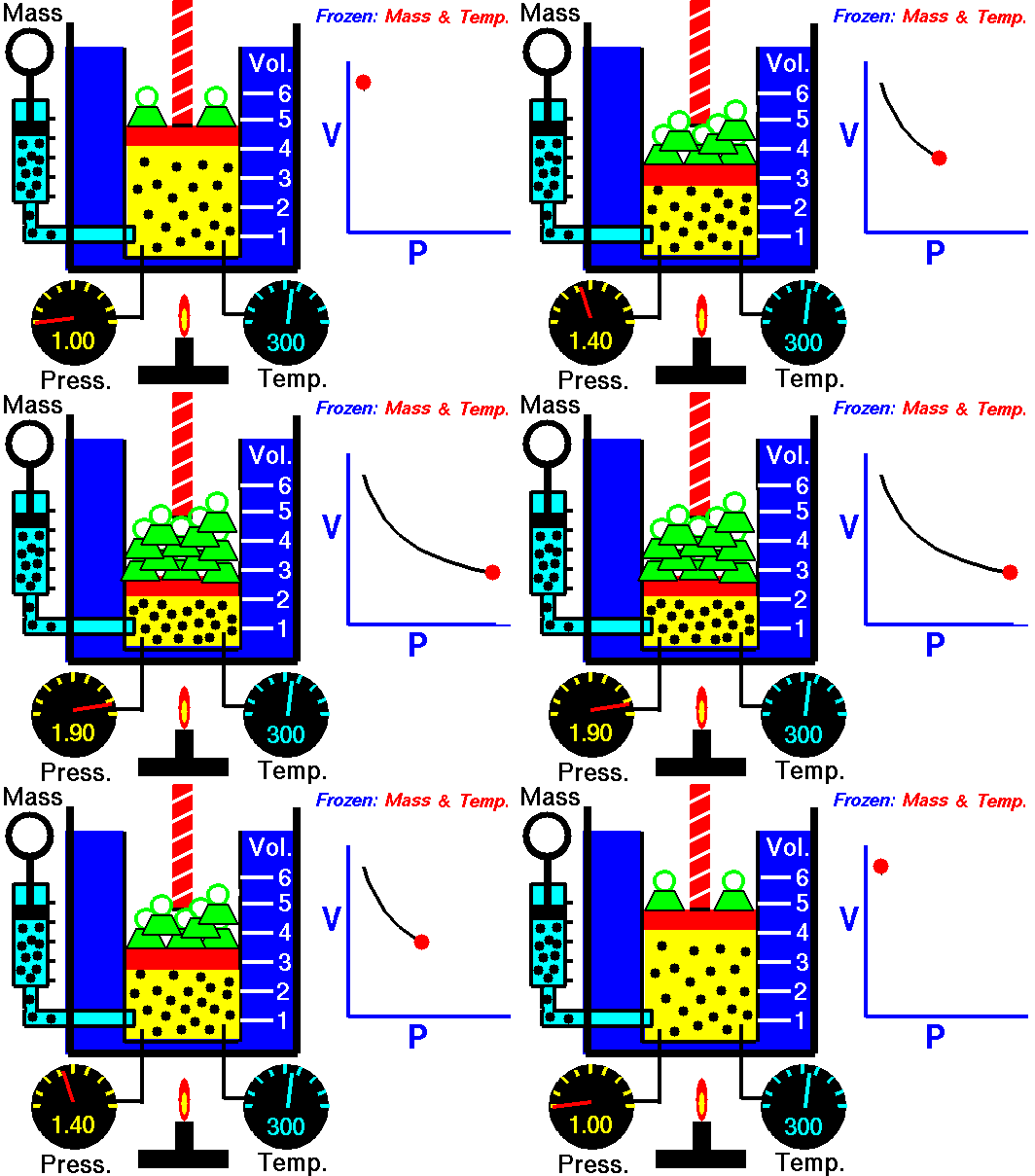
A slide and text version of this slide is also available.
Air is a gas. Gases have various properties which we can observe with our senses, including the gas pressure (p), temperature, mass, and the volume (V) which contains the gas. Careful, scientific observation has determined that these variables are related to one another, and the values of these properties determine the state of the gas.
In the mid 1600's, Robert Boyle studied the relationship between the pressure p and the volume V of a confined gas held at a constant temperature. Boyle observed that the product of the pressure and volume are observed to be nearly constant. The product of pressure and volume is exactly a constant for an ideal gas.
p * V = constant
This relationship between pressure and volume is called Boyle's Law in his honor.
In a scientific manner, we can fix any two of the four primary properties and study the nature of the relationship between the other two by varying one and observing the variation of the other. This slide shows a schematic "gas lab" in which we can illustrate the variation of the various properties. In the lab a theoretical gas is confined in a blue container. The volume of the gas is shown in yellow and is determined by the position of a red piston. The volume can be changed by moving the red piston using the red screw at the top of the piston. The number of moles of the gas is indicated by the number of small black "molecules" in the volume. The moles can be changed by injecting or withdrawing molecules using the pump at the left. There are two probes inserted into the bottom of the container to measure the pressure and the temperature. The pressure can be changed by adding or removing green weights from the top of the red piston, and the temperature can be changed by heating the container with the "torch" at the bottom.
Boyle's law (sometimes referred to as the Boyle-Mariotte law) is one of the gas laws and basis of derivation for the ideal gas law, which describes the relationship between the product pressure and volume within a closed system as constant when temperature remains at a fixed measure; both entities remain inversely proportional.[1][2] The law was named for chemist and physicist, Robert Boyle who published the original law in 1662. The law itself can be defined succinctly as follows
Boyle's Law is named after the Irish natural philosopher Robert Boyle (Lismore, County Waterford, 1627-1691) who was the first to publish it in 1662. The relationship between pressure and volume was brought to the attention of Boyle by two friends and amateur scientists, Richard Towneley and Henry Power, who discovered it. Boyle confirmed their discovery through experiments and published the results. According to Robert Gunther and other authorities, Boyle's assistant Robert Hooke, who built the experimental apparatus, may well have helped to quantify the law; Hooke was accounted a more able mathematician than Boyle. Hooke also developed the improved vacuum pumps necessary for the experiments. The French physicist Edme Mariotte (1620-1684) discovered the same law independently of Boyle in 1676, so this law may be referred to as Mariotte's or the Boyle-Mariotte law.
Boyle's law states that the volume of a gas increases when the pressure decreases at a constant temperature. Also it is the most fundamental of the 23 gas laws, which does states the constant relationship between pressure and volume within a system which does not have pressure or temperature at extreme ranges; high pressure or temperatures showing deviations from the law.[3] The law was not likely to have deviations at the time of publication due to limits upon technology, but as further technological advances occurred limitations of the approach would have become known, as Boyle's law relates more effectively to real gases[3] due to its description of such gases consisting of large numbers of particles moving independently of each other.[3]
In 1738, Daniel Bernoulli derived Boyle's law using Newton's laws of motion with application on a molecular level, but remained ignored until c. 1845, when John Waterston published a paper building the main precepts of kinetic theory, but was rejected by the Royal Society of England until the later works of James Prescott Joule, Rudolf Clausius and Ludwig Boltzmann firmly established the kinetic theory of gases and brought attention to both the theories of Bernoulli and Waterston.[4]


